A current, cross-case register of the people and companies behind US-facing phone scams, the carriers and payment rails that make the calls reach American victims, and the evidence that survives a courtroom.
This report maps the phone-scam economy behind a US debt-relief robocall campaign and the enablers that make similar campaigns reach American victims. It is built from public records, not from a single victim's call log. The register contains 375 actors and entities, 152 of them entities, and 223 edges. Every row carries an evidence URL, a quote or precise record cite, a source type and a confidence label.[S1][S2][S3]
The campaign is not a collection of unrelated brands. It is a family of ten US entities and four individuals, named in 19 federal TCPA dockets and MDL No. 3123, with a final Minnesota Department of Commerce consent order dated 2024-10-03. The brands the caller speaks, including Rencrest Capital, Iron View Financial, Waypoint Financial and Seacoast Lending, have no corporate existence. They are the script's watermark, not a defendant.[S32][S31]
The public record supports 33 candidate Better Debt numbers: 9 multi-cluster numbers in the FCC complaint graph and 24 transcript-linked voicemail lines. It does not support 200. The largest rotating pools in the FCC data are 216, 198, 116 and 113 numbers. Two of them match the Alliant Financial campaign on brand and window: the FCC's May 20, 2024 cease-and-desist letter names Alliant Financial and Mohammad Hossain, its member of management, and reports YouMail estimates of 16.1 million Alliant, 13.5 million Main Street Financial and 48.7 million One Street Financial calls, 78.3 million in total. The per-number subscriber is still unnamed. The same day, a K4 public notice allowed US carriers to block Alliant's traffic outright. The report keeps that distinction: a cluster is an operation, not a defendant.[S4][S37][S38]
The US carrier layer is documented. Five RespOrgs hold the campaign's 31 toll-free lines: Excel Telecommunications (12), Telnyx (9), Inteliquent (5), thinQ (4) and Pestilence Labs (1). Inteliquent and thinQ have public enforcement records. Two additional US gateways, Telcast Network LLC and Peerless Network, Inc., have FTC cease-and-desist letters naming debt-relief and other campaigns. None of these carriers is campaign-attributed to Better Debt Solutions. They are the regulator and subpoena lane, not the private defendant.[S6][S7][S8][S10][S11][S12]
The class-action route is narrower than it looks. MDL 3123 was denied centralization, leaving 19 separate dockets. No settlement or consumer-redress fund exists in any Better-family matter. Payment processors, lead buyers, brokers, offshore centers, brand-only shells and the individual controllers' assets are named in no class action. That is the white space a firm could file into.[S19][S31]
Use the operator family for the direct TCPA case. Use the carriers and processors for the regulator lane and for subpoenas. Do not sue a carrier on carriage alone. Build the evidence file before the demand letter. The middle layers are the gap, and the subpoena is the bridge.
The unit of analysis is the actor, not the number. A number is evidence of a call. An actor is a person or company that can be served, subpoenaed or referred to a regulator. The register links actors to entities, numbers, cases and edges.[S1]
| Source class | What it proves | Label |
|---|---|---|
| Court records and dockets | Named defendants, captions, procedural status, counsel | citable |
| FTC, FCC and state AG letters and orders | Notice, traceback counts, forfeitures, consent orders | citable |
| Corporate registries and SEC filings | Entity existence, officers, addresses, parents | citable |
| FCC unwanted-calls corpus | Caller ID, advertised callback, call type, date, state | citable |
| FTC Do Not Call data | A second independent complaint stream | lead |
| Complaint sites and social posts | Script variants, victim harm, rep names and brands | lead |
| Client voicemails and call log | The client's own record of the call | citable |
| Pattern and network analysis | Clusters, links and hypotheses | inference |
The FCC corpus extraction covered 170,260 rows and 86,963 distinct 8xx numbers. The number graph uses the advertiser-caller relationship: the advertised callback is the storefront, and every caller ID that advertised it is part of a rotating pool. The script graph uses the victim report text. The two graphs are kept separate because a number match is not a script match, and a script match is not an actor.[S4][S18]
Every actor carries a status label: convicted adjudicated partially-adjudicated settled-no-admission dismissed-with-prejudice named-not-adjudicated identified-not-charged no-public-record. A name in a complaint is not a finding. An arrest is not a conviction. A regulator's letter is not a judgment.[S20]
| Layer | What it does | Current actors | Reachable by |
|---|---|---|---|
| 1. Operator | Runs the brands, scripts and intake | Better Debt Solutions LLC and nine affiliates; Ghanbari, Ghafarinia, Gavilanes, McBride | TCPA § 227(b)(3)/(c)(5); state UDAP; RICO after a documented fee |
| 2. Lead and dialer | Generates the calls and the leads | LeadsRefer, HyperTarget, SalesPromis, Ithon, Merkavoix | TCPA vicarious; TSR; subpoena for traffic records |
| 3. Carrier and RespOrg | Holds the 1-8xx number and routes the call | Excel, Telnyx, Inteliquent, thinQ, Pestilence Labs; Telcast and Peerless as gateways | Regulator and subpoena; TSR substantial assistance only with notice |
| 4. Broker / auction | Sells the live call to a closer | Not named in any public record | Discovery; the seed advertisers are the bridge |
| 5. Call center | Answers and qualifies the victim | One Ten Communications (Karachi), HIMS/Hello International (Karachi), Globex, Stratics | Criminal referral; MLAT; US payment rail |
| 6. Payment | Takes the fee and moves the money | Nexway, Nuvei, Paddle, Ace Business Solutions; Axis Digital in the crypto tier | TSR; FTC Act § 5; wire and mail fraud; subpoena |
| 7. Enabler | Registrar, host, mail, ads | GoDaddy, Cloudflare, Google, Meta | Abuse process; Rule 45; preservation |
The table is not a list of defendants. It is a list of places where the record exists. The operator family is the only layer with a currently pleadable private TCPA case. The carriers and processors are the layers where a regulator can act and a subpoena can name the subscriber. The broker and the offshore center are the layers where the public record stops.[S20][S19]
The master register is normalized into five scheme types. An actor can appear in more than one. The counts below are cluster memberships, not unique actors.[S5]
| Scheme | Operator / owner | Lead / broker | Carrier / gateway | Payment | Other | Total |
|---|---|---|---|---|---|---|
| Debt / financial | 70 | 8 | 13 | 4 | 22 | 117 |
| Health / insurance | 10 | 35 | 3 | 0 | 8 | 56 |
| Crypto / romance | 35 | 0 | 0 | 14 | 3 | 52 |
| Tech / government | 18 | 0 | 5 | 6 | 6 | 35 |
| Warranty / solar | 10 | 3 | 2 | 0 | 4 | 19 |
| Other / cross-cutting | 12 | 8 | 20 | 7 | 63 | 110 |
The health vertical is a lead-broker business: 35 of its 56 memberships are lead generators or brokers. The crypto vertical is an operator-and-payment business: 35 operator memberships and 14 payment memberships. The debt vertical is the most balanced, with operators, lead brokers, carriers, brands and payment. That balance is why the debt campaign is the best-documented end-to-end chain in the file.[S5]
These actors appear in two or more scheme types. They are the highest-value targets because they profit from more than one campaign, and the common layer is usually the carrier or the lead broker.[S5]
| Actor | Role | Scheme types | Status | Source |
|---|---|---|---|---|
| Telcast Network LLC | Gateway | Debt, tech, warranty | named-not-adjudicated | S7 |
| Peerless Network / John Barnicle | Carrier | Debt, tech, warranty | named-not-adjudicated | S8 |
| DigitalIPvoice, Inc. | Gateway | Debt, health | named-not-adjudicated | S12 |
| XCast Labs Inc. | Gateway | Health, warranty | named-not-adjudicated | S21 |
| Fluent LLC | Lead generator | Health, warranty | settled-no-admission | S21 |
| One Ten Communications | Call center | Debt, tech | identified-not-charged | S13 |
| Superior Servicing, LLC | Operator | Debt, tech | named-not-adjudicated | S1 |
| Talal Khalid | Owner / gateway | Tech, warranty | identified-not-charged | S7 |
| Thomas Dorsher | Operator | Tech, warranty | template | S17 |
| Muhammed Rizwan | Operator | Health, warranty | named-not-adjudicated | S17 |
| Nuvei Corporation | Payment | Tech, cross-cutting | settled-no-admission | S1 |
A toll-free number is a storefront with a registry record. The RespOrg is the entity that manages the number in the Somos registry. The carrier connects the call. Neither is the caller. The carrier is paid by the minute, so it profits from the traffic whether or not the scam succeeds.[S6]
| RespOrg | ID | Campaign lines | Provisioned | Public enforcement |
|---|---|---|---|---|
| Excel Telecommunications | TUI02/03/07 | 12 | 2026-02-18 to 2026-10-08 | None found |
| Telnyx | QIT01 | 9 | 2019-06-03 to 2025-03-24 | None found |
| Inteliquent | LQX01 | 5 | 2026-03-06 to 2026-08-21 | FTC warning 2022; Task Force notice 2025; 9,712 tracebacks |
| thinQ | VNI01 | 4 | 2020-11-03 to 2024-11-07 | FCC cease-and-desist 2022 |
| Pestilence Labs LLC | EFP01 | 1 | 2026-02-18 | None found |
Two additional US gateways sit outside the 31-line set but on the same infrastructure. Telcast Network LLC (Talal Khalid, Dover, Delaware) received an FTC cease-and-desist on 2023-03-17 for five campaigns and a second-and-final Task Force notice in April 2025 stating that it "continues to transmit" and did not take sufficient steps after the CID. Its FCC Form 499 status moved to inactive on 2024-04-01. Peerless Network, Inc. (John Barnicle, Chicago) received an FTC cease-and-desist on the same date naming 25 campaigns, including two debt-relief campaigns, and a Task Force notice on 2025-12-03 citing 5,662 tracebacks since January 2019.[S7][S8][S9][S10]
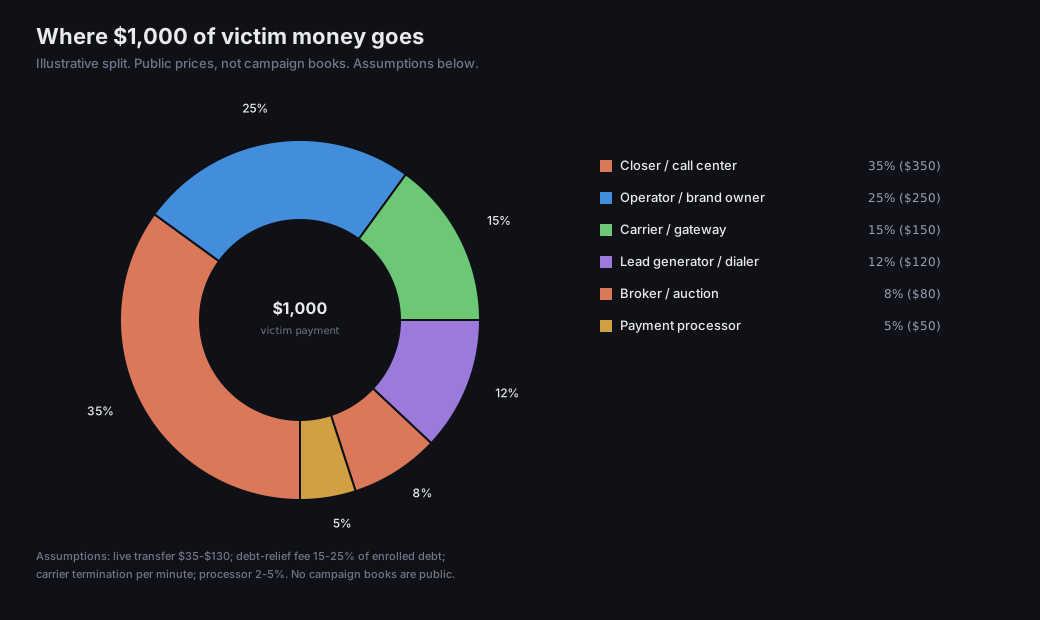
A carrier that only carries a call is not a private TCPA defendant. The private right of action reaches the party that makes or initiates the call. The carrier is a regulator target, a subpoena route, and a potential TSR substantial-assistance defendant only when its own conduct after notice is shown. The FTC letters and the Task Force notices are the notice evidence.[S7][S8][S11][S29]
Each typology uses the same seven roles. The differences are the script, the victim data and the payment rail.[S5]
The victim sees a fake virus warning or receives a call about a computer problem. The caller claims to be Microsoft, Apple or Amazon, asks for remote access, then charges for a repair. The payment is by card. The processor is the chokepoint. The FTC's Nexway case, the Paddle settlement and the Restoro/Reimage settlement are the current precedents. FirstIdea Infotech in Noida and MUSK Communications in Bengaluru were raided in 2025.[S21][S22]
Evidence. The pop-up URL, the callback number, the call recording, the remote-session log, the card statement and the merchant descriptor.[S23]
The script is a pre-approval for a $41,200 to $41,600 hardship loan. The caller claims TransUnion and Equifax have updated the file. The callback is a 1-8xx number. The operation is the best-documented end-to-end chain in the file: ten entities, four individuals, 19 dockets, 33 candidate numbers, four script families, five RespOrgs, and a final state consent order.[S1][S4][S18]
Evidence. Voicemail audio and transcript, callback number, caller ID, carrier CDR, bank or card statement, and the FTC/FCC complaint rows.[S23]
The caller offers a new government program or a final-expense benefit. The victim gives a Medicare number, a date of birth or a payment. The lead-broker layer is the largest in this vertical. Simple Health and Steven Dorfman were hit with a $195 million judgment and a permanent telemarketing ban. Assurance IQ and MediaAlpha paid $145 million. The DOJ sued eHealth, SelectQuote and GoHealth in May 2025. The HIMS case in Karachi is charged with $703.8 million in Medicare claims.[S15][S16][S24][S14]
Evidence. Enrollment documents, call recording, policy number, commission statement if obtainable, and the bank or card record.[S23]
The caller says the vehicle warranty is expiring or the home qualifies for solar. The FCC's auto-warranty case identified eight US providers carrying the traffic and assessed a $299,997,000 forfeiture against the Sumco Panama enterprise. CarShield paid $10 million in 2024. The vertical is smaller in the register, 17 actor memberships, but it uses the same carrier and payment layer.[S17][S25]
Evidence. The mailer, call recording, contract, payment record and caller ID.[S23]
The first contact is a wrong number, a dating match or a friendly message. Weeks later, the victim is on a fake investment platform. The money leaves by crypto or a US shell company. Prince Group and Chen Zhi were OFAC-designated, with about $15 billion in forfeiture. The Shunda and Tai Chang managers were charged, with more than $700 million restrained. The SEC brought its first pig-butchering cases against NanoBit and CoinW6. Huione Group was cut off by FinCEN under Section 311. The US laundering tier moved $36.9 million through US shell companies and banks into USDT.[S26][S27][S28]
Evidence. Chat logs, platform URL, wallet addresses, transaction hashes, bank wires and fake balance screenshots.[S23]
| Theory | Reaches | What it needs | Viability today |
|---|---|---|---|
| TCPA § 227(b)(3) | The party that makes or initiates the call | Artificial or prerecorded voice; one call; no consent | viable against the operator family |
| TCPA § 227(c)(5) | The same entity or its agent | Two calls in 12 months; DNC registration; no consent | viable against the operator family |
| Vicarious TCPA | A seller or lead buyer that controlled or ratified the calls | Actual authority, apparent authority or ratification | plausible with contracts or control evidence |
| TSR § 310.3(b) | A carrier or processor that knowingly assisted | Notice plus continued service; conscious avoidance | regulator lane; not a private TCPA claim |
| RICO § 1962(c)/(d) | The operator family and its enablers | Enterprise, pattern, domestic injury, a documented fee | after payment proof |
| FTC Act § 5 / state UDAP | The seller and the lead generator | Deceptive practice; state penalty authority | regulator lane; private route state-specific |
| Criminal wire/mail fraud | US VoIP providers and offshore centers | Scheme, interstate communication, intent | referral; Augustinsky is the template |
Three cautions. First, a carrier is not a private TCPA defendant on carriage alone, and the Stratics Networks case was dismissed with prejudice under Section 230 on 2024-03-06. Second, a brand name is not an entity. Third, a name in a complaint is not a finding; the status table in the register is the control.[S29][S20]
In Arizona, small claims is capped at $5,000, no attorney may appear, and a TCPA case can be removed to federal court. The class action or an existing member case is the better economic route. The TCPA is not a fee-shifting statute, and the statutory damages are $500 per call, or $1,500 for a willful violation.[S19]
The lawyer's warning that a phone dump is "hearsay" is too broad. Machine-generated call-log rows are not statements. Text messages and voicemails are opposing-party statements when offered against the caller. The real gate is authentication under FRE 901, not hearsay. Chain of custody goes to weight.[S23]
A defensible file has four layers: the client's testimony and device, a hash-verified export with a declaration, the carrier's call detail records, and a forensic extraction only if the authenticity is challenged. The original voicemail audio matters more than the transcript. The carrier's business record matters more than the handset log.[S23]
| Question | Answer | Status |
|---|---|---|
| Is a phone dump hearsay? | Not as a class. Machine rows are not statements; texts and voicemails are party admissions. Authentication is the gate. | research memo |
| Can a carrier be sued under § 227? | Not on carriage alone. TSR and regulator routes only. | case law |
| Is the campaign linked to Better Debt? | The script and the dockets support it; a payment record would prove it. | lead |
| Who owns the 216-number pool? | The per-number subscriber is not public. At operation level the FCC names Alliant Financial and Mohammad Hossain, and the 216 and 113 pools match its Main Street and One Street scripts. The seed advertiser is the bridge. | open |
| Is any processor campaign-attributed? | No. The ACH descriptor and merchant ID are the missing bridge. | open |
The limits are real. The FCC corpus is a complaint record, not an ownership record. Caller ID can be spoofed. The RespOrg is not the subscriber. The offshore layer is outside US jurisdiction for a private case. The register marks each gap rather than filling it with an inference.[S4][S6]
The full register has a source URL and a confidence label on every row. The appendix below covers the claims in this report. Where a record is a government or court document, it is marked citable. Where it is press, a vendor page or a community report, it is marked lead.
This report is research, not legal advice. It does not assert liability against any person or entity. A name in a complaint is a lead, not a finding. The status of every actor is recorded in the register, and the register is current to 2026-10-22.