John Sabo
Investigative dossier · 2026

The phone-scam economy, mapped.

A 375-actor register, the 33 Better Debt numbers the public record supports, and the US carriers and payment rails that make the calls possible. Built from court records, regulator letters, FCC complaints, and the client's own voicemails. Every claim carries a source.

375 actors and entities 152 entities 223 edges 5 scheme types every row cited
375
actors and entities in the register
33
Better Debt candidate numbers
5
scheme types, one shared infrastructure
11
cross-vertical enablers

A map of who profits, not another list of bad numbers.

The public conversation about robocalls stops at the caller ID. This report goes behind it. It follows the call from the lead list to the dialer, from the dialer to the toll-free storefront, from the storefront to the carrier, from the carrier to the call center, and from the call center to the payment rail.

The register is built from public records: federal and state court dockets, FTC and FCC enforcement letters, the multistate Anti-Robocall Task Force notices, corporate registries, FCC complaint data, and the client's own voicemail recordings. Every row carries an evidence URL, a quote or record cite, a source type, and one of three labels: citable lead inference. A name in a complaint is not a finding. A regulator's letter is not a judgment. The register keeps those lines visible.[S1]

The central distinction

Campaign linkage is not ownership. The FCC records the number a consumer complained about. It does not name the subscriber. A number can be spoofed. The report separates what the record proves from what the pattern suggests, and it names the subpoena or regulator that would close each gap.
Three ways into the same evidence.

The network

Connection map

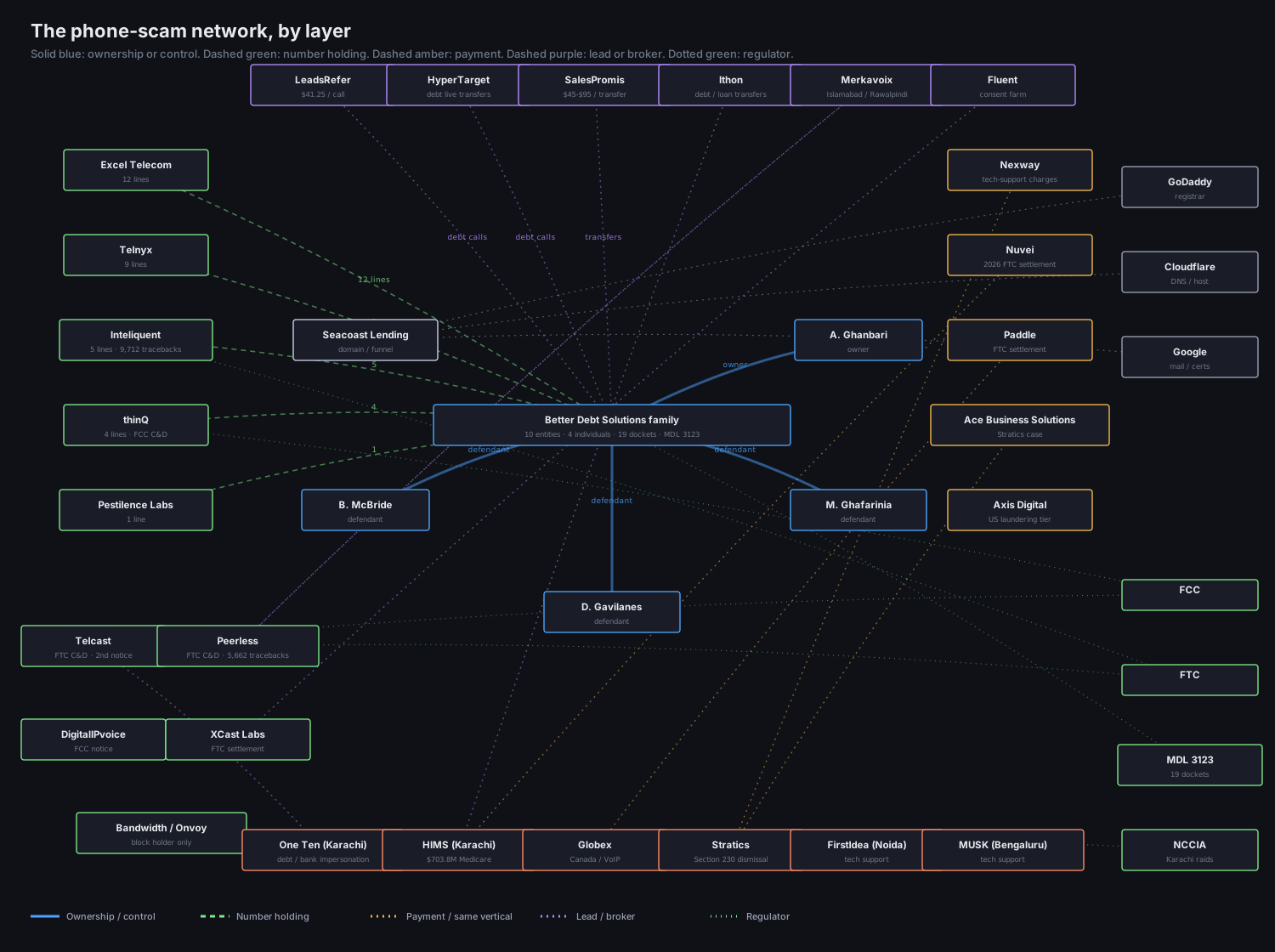
Operators, carriers, payment processors, lead brokers, call centers, enablers and regulators, drawn by layer. Solid lines are ownership or control. Dashed lines are carriage, payment, lead or broker relationships. The map is generated from the register, not drawn by hand.[S3]

The actors

375-row register

Name, role, country, scheme type, status, currency and confidence for every actor and entity, with a source link on every row. The status labels are exact: convicted, adjudicated, settled without admission, dismissed, named but not adjudicated, identified but not charged, or no public record.[S1]

The money

Profit model

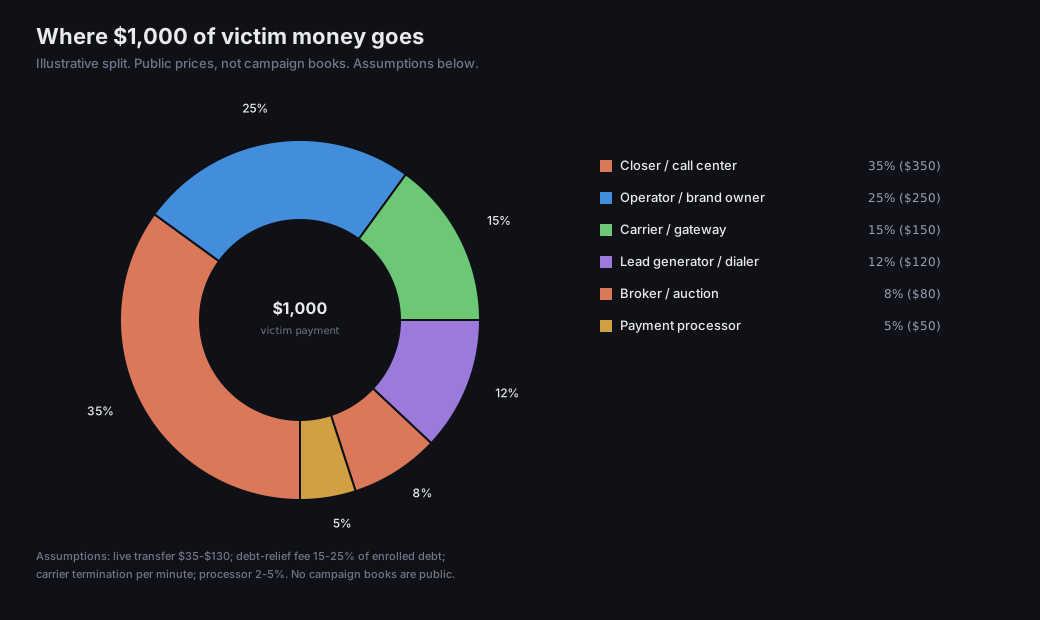
An estimated split of a victim payment across the closer, the operator, the carrier, the lead generator, the broker and the processor. Public prices and stated assumptions, not campaign books. The carrier slice is the one that makes the rest possible.[S6]

The chain, by layer.

The campaign at the center is the Better Debt Solutions family: ten entities, four individuals, nineteen federal TCPA dockets and MDL No. 3123. Around it sit the five US RespOrgs that hold its 31 toll-free lines, the payment processors with public enforcement records, the lead brokers that sell debt-relief transfers, the offshore call centers, and the registrars and hosts behind the victim-facing site.[S1][S6]

Connection map of the phone-scam network: Better Debt Solutions family, carriers, payment processors, lead brokers, call centers, enablers and regulators.
Figure 1. The phone-scam network, by layer. Node color marks the layer. Solid blue is ownership or control; dashed green is number holding; dashed amber is payment or same-vertical; dashed purple is lead or broker; dotted green is a regulator. Edges and node sources are in the register and the source appendix.

Where a victim payment goes.

The victim pays once. The money is split many ways. The closer and the call center take the largest share, the operator and brand owner take the next, and the carrier takes a per-minute fee for connecting the call. The carrier does not need the scam to succeed; it is paid for the traffic.[S6]

Estimated split of 1,000 dollars of victim money: closer 35 percent, operator 25 percent, carrier 15 percent, lead generator 12 percent, broker 8 percent, processor 5 percent.
Figure 2. Illustrative split of $1,000 of victim money. The percentages are an estimate from public price data: live transfers at $35 to $130, debt-relief fees at 15 to 25 percent of enrolled debt, carrier termination per minute, and processor fees at 2 to 5 percent. No campaign books are public.
The carrier slice

Five US RespOrgs hold the campaign's 31 toll-free lines: Excel Telecommunications (12), Telnyx (9), Inteliquent (5), thinQ (4) and Pestilence Labs (1). Inteliquent and thinQ have public enforcement records. Two more US gateways, Telcast and Peerless, have FTC cease-and-desist letters naming debt-relief and other campaigns. None of these carriers is campaign-attributed to Better Debt Solutions. They are the subpoena and regulator lane, not the defendant.[S6][S7][S8][S9][S10]

The same numbers do not stay, and the callback does not answer.

Three of the campaign's exact numbers carry more than 100 FTC Do-Not-Call complaints each in September and October 2026: 833-684-5548, 833-662-5670 and 888-912-0671. The campaign's own callback lines carry 0 to 2 complaints each. The reason is not that the calls stopped. The campaign rotates numbers faster than complaints accumulate, and the callback is a display or tracking number, not a working inbound line.[S4][S18]

The public record supports 33 Better Debt candidate numbers: 9 multi-cluster numbers in the FCC graph and 24 transcript-linked voicemail lines. The largest rotating pools in the dataset are 216, 198, 116 and 113 numbers. Two match a named campaign: the FCC's 2024 cease-and-desist letter names Alliant Financial and Mohammad Hossain and reports YouMail estimates totalling 78.3 million prerecorded calls across its three scripts. The per-number subscriber is still unnamed, which is the line between a cluster and a defendant.[S4][S21]

FindingWhat the record showsStatusSource
Better Debt family10 entities, 4 individuals, 19 TCPA dockets, MDL 3123, final Minnesota consent order (2024-10-03, $10,000)citableS1
33 candidate numbers9 FCC multi-cluster plus 24 transcript-linked voicemail lines; 866-606-6413 appears as an advertised callback in one FCC rowleadS4
Five RespOrgsExcel 12, Telnyx 9, Inteliquent 5, thinQ 4, Pestilence Labs 1citableS6
US gateway noticesTelcast and Peerless FTC cease-and-desist letters; Inteliquent FTC warning and AG notice; thinQ FCC cease-and-desistcitableS7-S11
Cross-vertical enablers12 actors appear in two or more scheme types; carriers and lead brokers dominateinferenceS5

For the people who have to prove it.

Plaintiff firms

Match a client to a party

The class-action map lists the 19 TCPA dockets, MDL 3123, the plaintiff firms on each, the class definitions, the white space, and the limitations window. It says where a new client can join and where no one has filed.[S20]

Regulators and journalists

Follow the infrastructure

The carrier and payment sections name the US chokepoints, the notice dates, the traceback counts, and the exact documents. The regulator lane is separate from the civil lane, and the report says which is which.[S7][S8][S9]

Start with the plain-English version. Then read the evidence.

The explainer walks through each scam type and the pieces required to run it. The professional report carries the full register, the legal theories and the source appendix.

How the scams work Full professional report

Every claim has a source.

The full register carries a URL, a quote or record cite, a source type and a confidence label on every row. The source list below covers the claims on this page. Where the record is a government or court document, it is marked citable. Where it is press, a vendor page or a community report, it is marked lead.

  1. [S1]Master actor register. 375 actors and 152 entities, one evidence URL per row. Local data room: actors.csv. citable / lead per row
  2. [S2]Master entity register. 152 entities, linked to actors and numbers. entities.csv. citable / lead per row
  3. [S3]Edge register. 223 edges: ownership, carriage, payment, lead and regulator links. edges.csv. citable / lead per row
  4. [S4]Number-to-actor clusters. 170,260 FCC unwanted-call rows, 86,963 distinct 8xx numbers, 4,383 multi-number pools, 33 Better Debt candidates. FCC corpus; local report number-clusters.csv. citable for the FCC rows; lead for cluster attribution
  5. [S5]Actor clusters by scheme type. Debt/financial 117, health/insurance 56, crypto/romance 52, tech/government 35, warranty/solar 19, cross-cutting 110; 11 cross-vertical enablers. actor-clusters.csv. inference from the register
  6. [S6]Carrier and RespOrg map. Five US RespOrgs holding the 31 lines; provisioning dates and line counts. Somos; local report org-map.csv. citable registry fact
  7. [S7]FTC cease-and-desist letter to Telcast Network LLC, 2023-03-17. ftc.gov PDF. citable
  8. [S8]FTC cease-and-desist letter to Peerless Network, Inc., 2023-03-17. ftc.gov PDF. citable
  9. [S9]Anti-Robocall Task Force notice to Peerless, 2025-12-03, 5,662 traceback notices. ag.hawaii.gov PDF. citable
  10. [S10]Task Force second-and-final notice to Telcast, April 2025. ncdoj.gov PDF. citable
  11. [S11]FTC warning letter to Inteliquent, 2022-05-10, and Task Force notice, 2025-12-03, 9,712 tracebacks. FTC; nmdoj.gov PDF. citable
  12. [S12]FCC cease-and-desist to thinQ Technologies, 2022-03-22. fcc.gov. citable
  13. [S13]DOJ, US v. Augustinsky, E.D. Va. 2:25-cr-97, convicted 2026-07-21. justice.gov. citable
  14. [S14]HHS-OIG / US v. Charolia et al., N.D. Ill. 1:25-cr-00304, $703.8M Medicare claims. justice.gov. citable
  15. [S15]FTC v. Simple Health, $195M judgment, 2024-02-09. ftc.gov. citable
  16. [S16]FTC, Assurance IQ and MediaAlpha, $100M and $45M, 2025-08-07. ftc.gov. citable
  17. [S17]FCC auto-warranty order and Sumco forfeiture, 2023-08-03. fcc.gov. citable
  18. [S18]Script fingerprints and client observations. Four script families, 44 variants; white American or AI-likely voice; callback does not answer. script-fingerprints.csv. citable as the client's record; lead for pattern
  19. [S19]Class-action and counsel map. 19 TCPA dockets, MDL 3123, 25 related proceedings, plaintiff firms, white space. class-action-map.csv. citable / lead per row
  20. [S20]Case records and unadjudicated actors. Methods of operation, network layout, abuse signals, exact status labels. case-evidence.csv. citable / lead per row
  21. [S21]FCC cease-and-desist letter to Alliant Financial, EB-TCD-23-00035896, 2024-05-20. Names Mohammad Hossain, member of management; reports 16.1 million Alliant, 13.5 million Main Street Financial and 48.7 million One Street Financial calls. fcc.gov. citable

The downloadable files are the same data the report uses. The register is current to 2026-10-22. A name in a complaint is a lead, not a finding. The report does not assert liability against any person or entity; that decision belongs to counsel and the court.